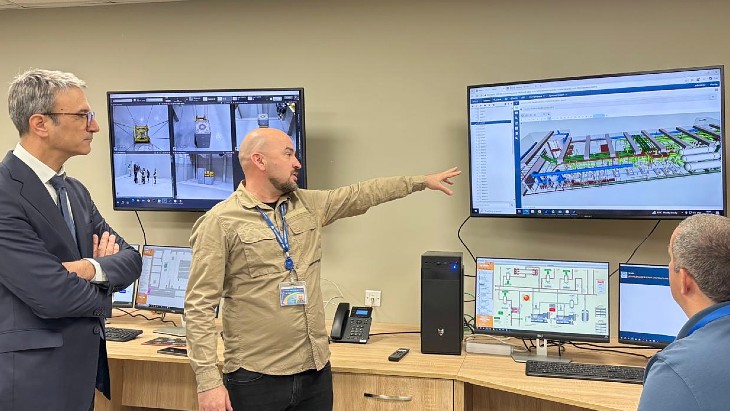
According to the Ministry of Energy the new national repository will consist of 66 reinforced concrete structures with a total capacity of 19,000 containers - or 138,200 cubic metres - of radioactive waste.
The ministry said: "The National Repository is intended for processed and secured radioactive waste generated solely on the territory of Bulgaria. It will store low- and intermediate-level waste from industry, medicine and household waste, and waste generated during the decommissioning of units I-4 of the Kozloduy NPP, as well as from the operation of future new nuclear facilities. High-level waste and spent nuclear fuel will not be stored."
The repository site is close to the Kozloduy nuclear power plant. It is a near-surface trench-type facility featuring multi-barrier protection for the storage of low- and intermediate-level waste in reinforced concrete packages. The first stage, has a capacity of 22 concrete "cells", which can store 6,336 containers. They will be filled with waste from the decommissioning of units 1-4 of the Kozloduy NPP alone.
The project was assigned to Bulgaria's State Enterprise for Radioactive Waste (SE RAW) by a government decision in 2005. After regional and detailed geological-geophysical, geochemical, engineering-geological and hydrogeological studies, the preferred Radiana site was selected. Construction began in August 2017.
The official opening was carried out by Energy Minister Traycho Traykov, who said: "It is a special honour for me to inaugurate the most modern industrial building in Bulgaria. This is a unique facility of the highest class, of which we can truly be proud." He added that it was "the culmination of the efforts of many people, that today one of the most modern repositories in Europe can be put into operation".
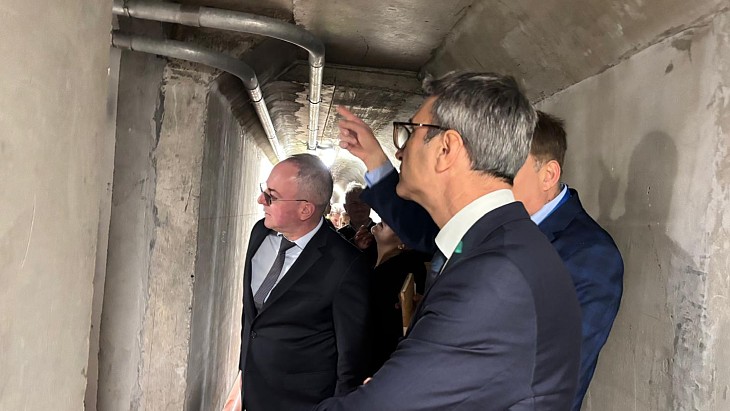
The minister joined a tour of the new facility (Image: Ministry of Energy)
Dilyan Petrov, Executive Director of SE RAW, said the facility was designed according to the highest safety requirements of the International Atomic Energy Agency, and its main function was "to ensure reliable and permanent isolation of radioactive waste from humans and the environment".
The construction of the repository was part of the commitments made by Bulgaria in its accession to join the European Union. During EU accession negotiations, Bulgaria also committed to closing Kozloduy 1 and 2 by the end of 2002 and units 3 and 4 by the end of 2006. All four units were V-230 model VVER-440 reactors, which the European Commission had earlier classified as non-upgradable. Bulgaria joined the EU on 1 January 2007. The Kozloduy International Fund has financed the project on a grant basis through the European Bank for Reconstruction and Development.
The official opening of the repository took place after the Directorate for National Construction Control issued a certificate last month declaring that the project had been completed in accordance with all requirements. A permit for commissioning the facility was issued by the country’s Nuclear Regulatory Agency last week.
In its announcement, the regulator said: "The new facility is the first of its kind on the Balkan Peninsula and provides for the complete and final disposal of low- and intermediate-level radioactive waste generated in Bulgaria. The commissioning is part of the phased plan for the implementation of the Strategy for the Management of Spent Nuclear Fuel and Radioactive Waste until 2030. The main goal is to build a sustainable and comprehensive system for the management of low- and intermediate-level radioactive waste in the country."
Bulgaria currently has two units operating at Kozloduy Nuclear Power Plant, with capacity of 2 GWe. There are plans to build two Westinghouse AP1000 units at Kozloduy, as well as various proposals for small modular reactors in the country.


_37830.jpg)
_31903.jpg)
_85344.jpg)