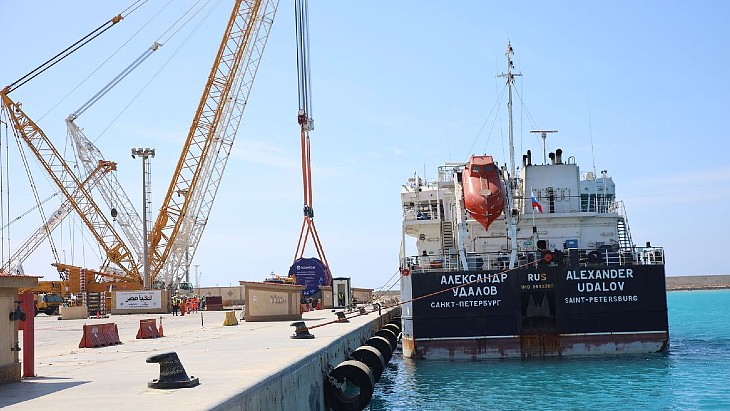
In addition to the 330-tonne reactor vessel for El Dabaa’s second unit, the other equipment - including the pressuriser for unit 1 - pushed the total cargo weight up to about 2,000 tonnes.
The items were manufactured at the Atomash plant in Volgodonsk in Russia's Rostock Region and delivered on the Alexander Udalov, a vessel designed for both river and maritime transport. This enabled the equipment to be delivered directly from the plant's pier to the specially constructed port at the El Dabaa NPP construction site.
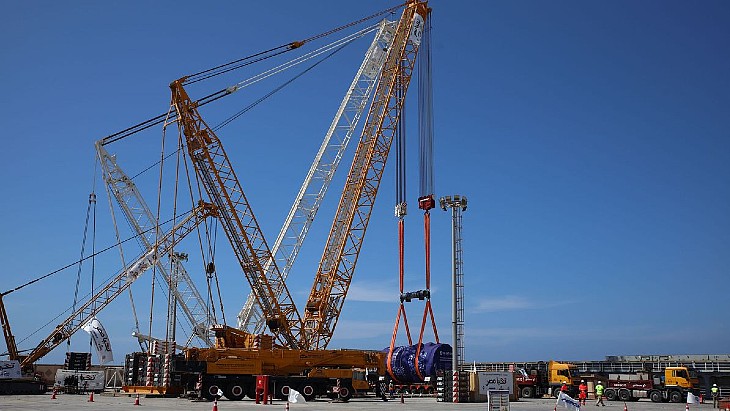
Lifting the equipment is a high-precision operation (Image: Rosatom)
The cylindrical steel reactor pressure vessel, with an initial service life of 60 years, with the possible extension to 80 years, houses the reactor core and ensures a hermetic seal and withstands high pressures and temperatures, ensuring the safety and reliability of the power unit.
It had a special 500-square-metre cover for its journey, comprimising two layers, a special canvas one to protect it from moisture during transport and a second, decorative, outer layer.
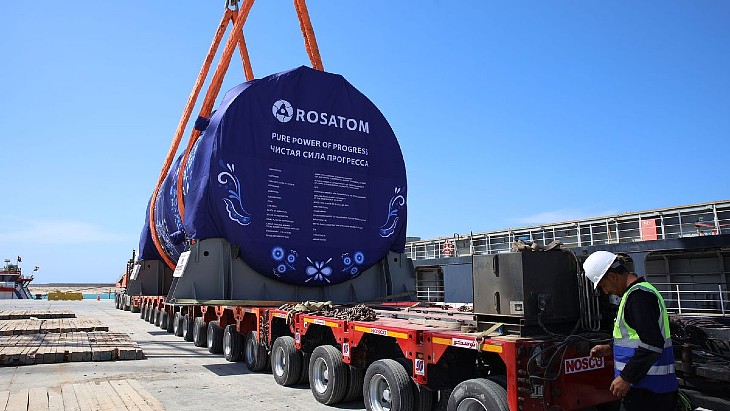
(Image: Rosatom)
According to Russia's state nuclear corporation Rosatom, "this shipment was the largest ever for a single nuclear power plant".
Alexey Likhachev, Rosatom Director General, said: "The equipment shipped to the El Dabaa NPP is essential for the transition to start-up operations for the first power unit and for the peak construction of the second power unit."
Minister of Electricity and Renewable Energy Mahmoud Esmat attended the unloading of the cargo at El Dabaa’s port. According to Egypt's Nuclear Power Plant Authority, he said the project was central to the national energy strategy, praised the strategic relations between Egypt and Russia, and added that the El Dabaa plant project was being implemented according to the timetable, including an increase in training programmes to prepare for future operation of the plant.
Background
El Dabaa will be Egypt's first nuclear power plant, and the first in Africa since South Africa's Koeberg was built nearly 40 years ago. The Rosatom-led project, about 320 kilometres north-west of Cairo, will comprise four VVER-1200 units, like those already in operation at the Leningrad and Novovoronezh nuclear power plants in Russia, and the Ostrovets plant in Belarus.
Under the 2017 contracts, Rosatom will not only build the plant, but will also supply Russian nuclear fuel for its entire life cycle, including building a storage facility and supplying containers for storing used nuclear fuel. It will also assist Egyptian partners in training personnel and plant maintenance for the first 10 years of its operation. Rosatom said last month that it is aiming for a future service life of 100 years for nuclear power plants.
The four units are being built almost concurrently, with first concrete at unit 1 in July 2022, followed in turn by the others, concluding with first concrete at unit 4 in January 2024. The reactor pressure vessel was delivered in October 2025 and installed in El Dabaa's first unit the following month, following a ceremony which included speeches from the Egyptian and Russian presidents.
Egypt's aim is for 9% of electricity to be generated by nuclear by 2030, which would be achieved by the commercial operation of the first two units by that time, directly displacing oil and gas.


_55567.jpg)
_51646.jpg)
_33474.jpg)
_85344.jpg)