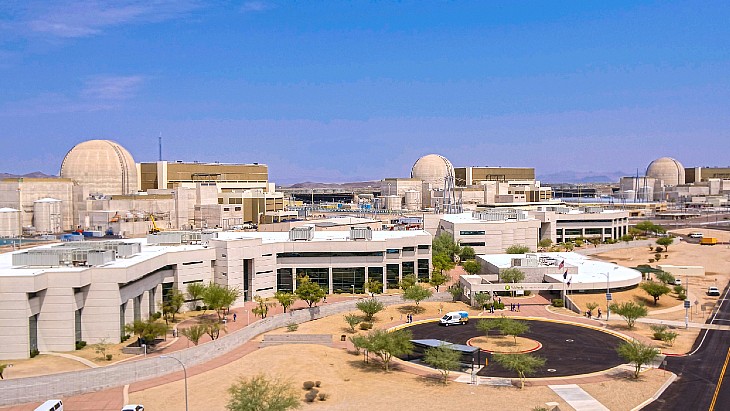
The Notice of Intent to submit a Subsequent License Renewal Application in late 2027 will take all three units to 80 years of operation - unit 1 to 2065, unit 2 to 2066, and unit 3 to 2067.
In the USA, commercial nuclear power plants are initially licensed by the Nuclear Regulatory Commission (NRC) to operate for up to 40 years. A first licence renewal covers an additional 20 years for an operating lifetime of 60 years, and subsequent licence renewals cover a further 20 years of operation beyond that, focusing on the management of plant ageing during the 60-80 year operating period.
Adam Heflin, Executive Vice President and Chief Nuclear Officer at Palo Verde Generating Station for Arizona Public Service (APS), said: "Nuclear power plants harness energy from atoms to produce electricity. It's one of the most rigorously regulated and carefully monitored energy sources in the country, and these facilities are designed with multiple layers of safety. Palo Verde Generating Station operates reliably and provides stable generation - helping keep the grid dependable and long-term energy costs more affordable for customers."
Palo Verde is the only US nuclear power plant not located on a body of water. Instead, it uses recycled municipal wastewater from the city of Phoenix for plant cooling. The plant has a generating capacity of 4.2 GWe. Palo Verde 1 and 2 entered commercial operation in 1986, followed by unit 3 in 1988. Unit 1 is currently licensed to operate until 2045, unit 2 until 2046 and unit 3 until 2047.
According to the Nuclear Energy Institute, the plant produces 27% of the state of Arizona's total electricity and 71% of its emission-free generation.
APS says Palo Verde produces enough electricity for four million homes, employs 2,100 full-time workers and contributes USD2.6 billion to local economies.
The plans to get a further licence extension for the units follows in the footsteps of others in the US to have had their licences extended to 80 years, According to World Nuclear Association information, the reactors approved to 80 years as of January 2026 were: Turkey Point 3&4, Peach Bottom 2&3, Surry 1&2, North Anna 1&2, Monticello, Oconee 1-3, Virgil C Summer 1, Point Beach 1&2, Browns Ferry 1-3, Dresden 2&3. Those with applications under review were St Lucie 1&2, HB Robinson 2, Edwin I Hatch 1&2.
In addition to plans to extend the life of the units, APS is collaborating with Salt River Project and Tucson Electric Power to assess possible locations for new nuclear capacity, including retiring coal plants.
Both small modular reactors and potential large reactor projects will be considered in the siting work. The trio has applied for a US Department of Energy grant to begin the preliminary search for a potential site under the Generation III+ Small Modular Reactor programme, an initiative announced in 2024 to provide a total USD900 million of support for SMR deployment. If approved, the grant would support a three-year site selection process and possible preparation of an early site permit application to the US Nuclear Regulatory Commission.


_37830.jpg)
_31903.jpg)
_85344.jpg)