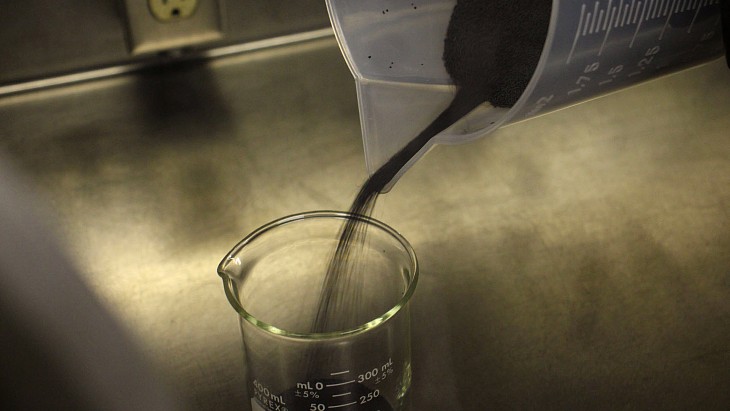
TRISO fuel comprises spherical kernels of enriched uranium oxycarbide (or uranium dioxide) surrounded by layers of carbon and silicon carbide, giving a containment for fission products which is stable up to very high temperatures. Thousands of these poppy seed-sized particles (see picture above) are then combined into compact fuel forms used in advanced reactors.
BWX Technologies (BWXT) said that fuel fabrication for Antares Nuclear began in October at its Lynchburg Speciality Fuels Fabrication facility, and when ready it will be shipped to Idaho National Laboratory, where Antares is building its pilot reactor.
Jordan Bramble, president and CEO of Antares, said: "By using a TRISO fuel specification and compact that BWXT knows well through the Pele programme, we're building on an established, high-confidence manufacturing foundation."
Last week California-based Antares announced that the US Department of Energy (DOE) had formally approved its Preliminary Safety Analysis for its demonstration reactor - Mark-0 - which is scheduled to go live before 4 July.
It said the demonstration was "a critical step toward generating electricity from advanced microreactors", saying it uses a full-scale core "and the same facility and fuel that will support our next reactor test in 2027".
The company announced on Thursday that it is more than doubling the size of its headquarters, from 145,000 square feet to 322,000 square feet, to allow integration of design, manufacturing and testing. It said "at steady state, the expanded facility is designed to support manufacturing our first 50 reactors, with a clear path to scale beyond that as demand grows".
Antares says its transportable sodium heat pipe-cooled R1 microreactor will provide between 100 kWe and 1 MWe, is "configurable into multi-MWe-sized microgrids for power and heat applications" and says its "passive heat pipe design enables 4 to 6 years of continuous power with few moving parts".
Specialist transport
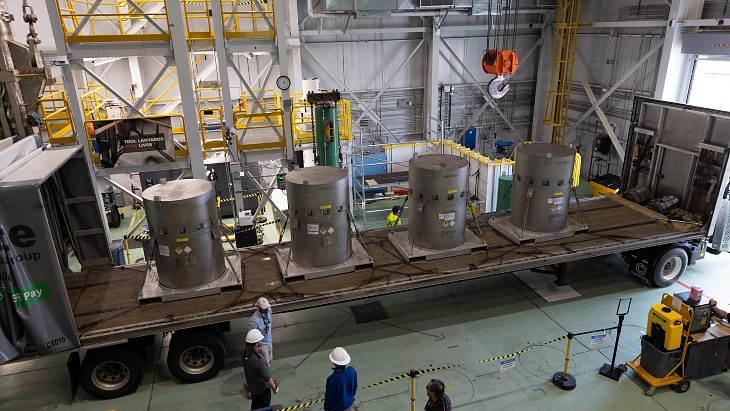
Casks arrive at INL containing TRSIO fuel for Project Pele (Image: INL)
The US Department of Energy last year began allocating amounts of high-assay low-enriched uranium (HALEU) produced by BWXT to advanced reactor developers, including Antares.
Joe Miller, BWXT president for Government Operations, said: "Many advanced reactor designs need safe, reliable TRISO fuel to power them, and we are the experienced leader in this area. We continue to deliver for our customers."
In December BWXT announced the arrival of TRISO fuel for the Department of Defense's Project Pele prototype microreactor - a 1.5 MW transportable power system - at Idaho National Laboratory (INL). The company is building the prototype microreactor at its Lynchburg site and will ship the completed prototype to INL, with formal testing expected in 2027.
The transport of the HALEU TRISO fuel was supported by NAC International, providing specialised transportation services using its OPTIMUS-L transportation packaging system, which is the first high-capacity packaging certified by the US Nuclear Regulatory Commission (NRC) for HALEU TRISO fuel transport.
The company said: "In this landmark operation, the entire initial core of the Project Pele reactor was transported using only four OPTIMUS-L systems in a single legal-weight truck shipment - a testament to the system’s efficiency and versatility. The shipment was completed without any damage to the fuel, ensuring the integrity of this critical material."
Antares was one of 11 reactor projects selected in August by the DOE for the Nuclear Reactor Pilot Program, which aims to see at least three of them achieve criticality in less than one year. The pilot programme, announced in June, aims to expedite the testing of advanced reactor designs that will be authorised by the Department at sites located outside of the national laboratories. Part of the Reforming Nuclear Reactor Testing at the Department of Energy executive order signed by President Donald Trump in May, its goal is "to construct, operate, and achieve criticality of at least three test reactors using the DOE authorisation process by 4 July 2026."


_37830.jpg)

_31903.jpg)
_85344.jpg)