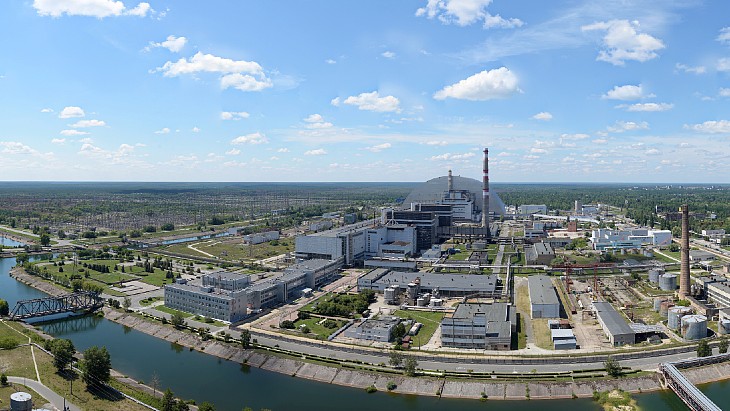
The State Agency of Ukraine for Exclusion Zone Management (SAUEZM) gave the update as it reported on activities in 2025, which included taking more than 4,000 samples and conducting more than 15,000 field and 9,000 laboratory measurements in the zone. It said "the radiation condition in the exclusion zone remained stable. No exceedances of control levels were recorded, no significant changes in the radiation situation were detected".
The report said the exclusion zone was a "promising platform for the development of renewable energy", with solar power plants and "initiatives in the field of bioenergy and circular economy" launched.
The agency said that, together with Energoatom, Ukraine's state nuclear energy giant, "work has continued on the placement of small modular reactors in the territory of the exclusion zone - currently potential sites have been proposed ... for the placement of small modular reactors in the areas of the villages of Kopachi and Leliv".
The Chernobyl exclusion zone covers an area within 30 kilometres of the plant. Both Kopachi and Leliv are in the inner part of the zone, within 10 kilometres of the Chernobyl nuclear power plant and have been abandoned since the accident in 1986. (Read more: World Nuclear Association's guide to the Chernobyl accident)
The agency also reported that the last year had seen continued development of infrastructure for radioactive waste management and research work on the creation of a geological repository for radioactive waste and spent nuclear fuel. It said there were 210 organised visits to the zone, including for representatives of the European Commission, the European Bank for Reconstruction and Development as well as diplomats and government representatives from the UK, the USA, Germany, France, the Netherlands, Switzerland and other countries and international experts in the field of nuclear and radiation safety.
Ukraine, whose largest nuclear power plant at Zaporizhzhia has been under Russian military control for nearly four years, has plans for new nuclear capacity - as many as nine new Westinghouse AP1000 large reactors across the country, as well as a programme for SMRs. Energoatom signed an agreement in 2024 which could pave the way for up to 20 of Holtec's SMRs. It has also been exploring options with a number of other potential SMR providers.


_33474.jpg)
_37830.jpg)
_85344.jpg)