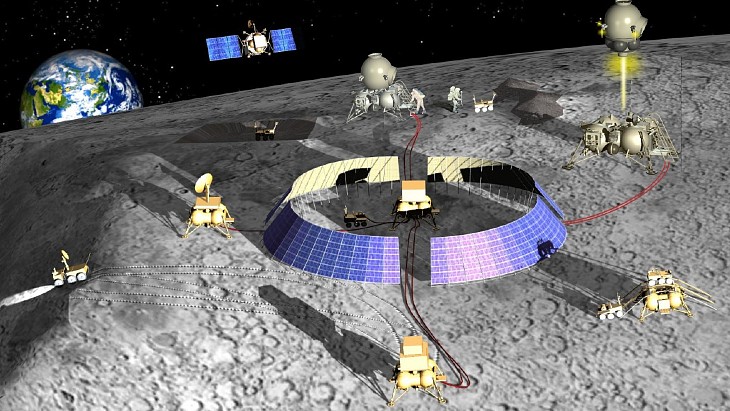
Roscosmos, Russia's federal space agency, said the purpose of the nuclear power station on the moon would be "long-term power supply to consumers (moon rovers, observatory) of the Russian Lunar programme, as well as infrastructure facilities of the International Lunar Research Station (including facilities of foreign partners)".
As part of the power plant project, which features Roscosmos, Rosatom and the Kurchatov Institute, there will be development of spacecraft, ground-based experimental testing, flight tests and deployment of infrastructure to the Moon. Roscosmos said the project was "an important step toward creating a permanent scientific lunar station and transitioning from one-time missions to a long-term lunar exploration programme".
According to Interfax, Vasily Marfin, CEO of NPO Lavochkin, said during his presentation at the plenary session of the 50th Academic Readings on Cosmonautics in Memory of Korolev, the missions in 2033 and 2034 would be for support and infrastructure delivery, with the power module transported to the Moon in 2035.
He was reported to have stressed the complexity of the project and the uncertainties, and added: "The power module is being developed in cooperation with Rosatom and under the scientific supervision of the Kurchatov Institute."
Russia and China have signed agreements over recent years to cooperate on the creation of a lunar base - with China National Space Administration and Roscosmos leading cooperation on the development of the International Lunar Research Station (ILRS).
A number of other countries, including Belarus, South Africa and Serbia, have signed up to participate in the project which, according to China’s official Xinhua news agency, is expected to be built in three phases in the 2030s.
It also reported in 2024 that Chinese researchers were considering basalt as a material to build the lunar base - using local materials on the moon would save large costs compared with sourcing materials from Earth.
The Reuters news agency reported last year on China’s '555' plan - which aims to invite 50 countries, 500 international scientific research institutions, and 5,000 overseas researchers to join the ILRS.
There are also other projects looking at establishing permanent lunar bases, including using nuclear energy as a power source. Earlier this month NASA and the US Department of Energy said they had recently signed a memorandum of understanding to solidify their collaboration and advance the "vision of American space superiority" set out in an Executive Order signed by US President Donald Trump on 18 December. As well as "returning Americans to the Moon by 2028" - through the Artemis Program - this order includes deploying nuclear reactors on the Moon and in orbit, including the development of a lunar surface reactor by 2030.
In Europe, France's Framatome and the Italian Agency for New Technologies, Energy and Sustainable Development, ENEA, announced last September that they were to explore advanced technological solutions for nuclear reactors to power future settlements on the Moon. Their memorandum of understanding covers three areas: studies regarding the fuel required for the reactor, with a view to ensuring both efficiency and safety; the development of new materials capable of withstanding the extreme conditions in space; and the use of additive manufacturing for reactor components.


_33474.jpg)
_37830.jpg)
_85344.jpg)