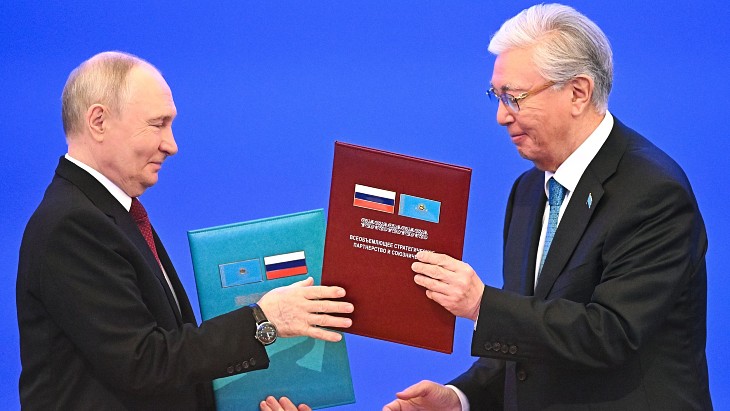
Following talks between the two presidents, a list of agreements signed by the two countries was published, including one "on the basic principles and conditions of cooperation on the project to build a nuclear power plant on the territory of the Republic of Kazakhstan".
Another agreement was "on the provision to the Government of the Republic of Kazakhstan of a state export loan to finance the construction of a nuclear power plant on the territory of the Republic of Kazakhstan".
A third nuclear-related agreement was on an action plan "in the field of interdepartmental cooperation in the field of nuclear and radiation safety regulation for 2026-2030".
Russia's state nuclear corporation Rosatom said the intergovernmental agreement "defines the key parameters of the nuclear power plant construction project. Specifically, it concerns the construction of two Russian-designed power units with VVER-1200 reactors based on best Russian practices. The document covers key areas of cooperation during the NPP's operational life, including maintenance and fuel supply".
Rosatom Director General Alexey Likhachev and Almasadam Satkaliyev, Chairman of Kazakhstan's Atomic Energy Agency, signed the agreements in the presence of the presidents.
Further details of the financing was not included in the official announcements, although the official news agency Kazinform said that preliminary estimates put the cost of the two units at about USD14.4 billion with another USD2 billion earmarked for physical security systems and social infrastructure. It quoted Satkaliyev as saying the export loan had "very favourable terms for Kazakhstan". It also reported that the construction start was targeted for 2027, and the aim was for operation of the first unit in 2034.
In their comments after their talks and the signing of the agreements, Kazakhstan's President Kassym-Jomart Tokayev said: "There's every reason to single out energy as a very successful area of cooperation. In my view, the agreement signed today on the construction of the Balkhash Nuclear Power Plant is of exceptional significance.
"I express my gratitude to the President of the Russian Federation for his personal and decisive support in launching this large-scale project, which will become a driving force for scientific, educational, and technological collaboration and will ensure the development of new related energy sectors and industry as a whole."
President Putin called it "a flagship project in the field of peaceful nuclear energy" and said "the commissioning of the plant will make a significant contribution to the energy supply of the Kazakh economy, helping to provide businesses and households with affordable and clean energy".
He added: "I would like to point out that, as we agreed with the President of Kazakhstan, we are not simply talking about the creation of a nuclear power plant or construction; we are talking about the creation of an entire industry, including education, personnel training, and so on."
Background
Kazakhstan is the world's leading producer of uranium. Although it does not currently use nuclear energy, it is not without nuclear experience: it has three operating research reactors, and a Russian-designed BN-350 sodium-cooled fast reactor operated near Aktau for 26 years, until 1999.
Kazakhstan has been preparing for a possible nuclear power programme to reduce its reliance on fossil fuels, diversify its energy mix and reduce CO2 emissions for some time. Kazakhstan Nuclear Power Plant (KNPP), a subsidiary of Kazakhstan's Samruk-Kazyna National Welfare Fund JSC, was set up in 2014. In a referendum in 2024 more than 70% of the 7.8 million people who voted answered 'yes' to the question: "Do you agree with the construction of a nuclear power plant in Kazakhstan?"
In June last year, Russia's Rosatom was selected as the leader of an international consortium to build Kazakhstan's first planned nuclear power plant - to be called the Balkhash plant - in the village of Ulken, in Zhambyl district, on the shore of Lake Balkhash. China National Nuclear Corporation is lined up to build a second one, at a site also in the Zhambyl district, adjacent to the site selected for the first plant, as well as a third plant, Kazinform News Agency reported last July.
The government has set a target for nuclear to produce a 5% share of the national generation mix by 2035.


_55567.jpg)
_51646.jpg)
_33474.jpg)
_85344.jpg)