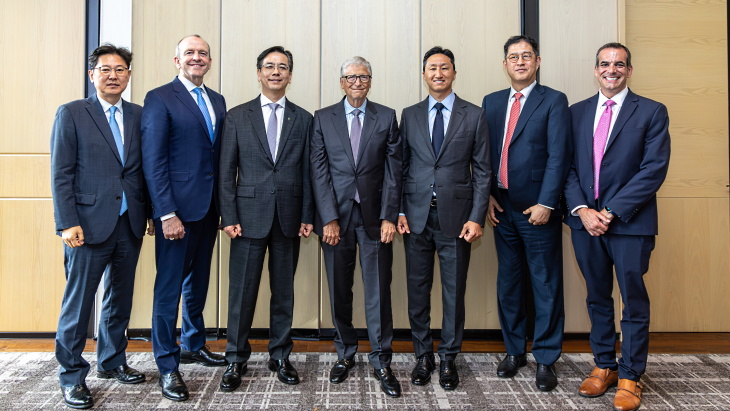
TerraPower founder and Chairman Bill Gates, along with the company's President and CEO Chris Levesque, met with South Korean Prime Minister Han Seong-sook and leaders from the Export-Import Bank of Korea, HD Hyundai, Hyundai Engineering & Construction (HDEC) and SK Innovation in Seoul on Friday to discuss the collaboration. It was the first meeting among the top executives of the three companies since HD Hyundai, TerraPower and HDEC signed a trilateral memorandum of understanding in May to cooperate on next-generation sodium reactor projects.
In May, as well as signing a framework agreement with HD Hyundai Heavy Industries - the shipbuilding subsidiary of HD Hyundai - making it TerraPower's strategic manufacturing partner, a separate memorandum of understanding was agreed between TerraPower, HD Hyundai and HDEC "to collaborate on the design, manufacturing, supply chain, construction, commercial structure and delivery of multiple units of TerraPower's Natrium technology".
TerraPower has now announced the signing of a framework agreement with HDEC to support the commercial deployment of Natrium reactors. Under the agreement, TerraPower selected HDEC as its engineering, procurement and construction (EPC) contractor to build up to eight of its future Natrium reactors with completion, price and performance guarantees, intended to facilitate conventional commercial financing of the Natrium reactor fleet. It said the collaboration will accelerate the commercial deployment of Natrium reactors by streamlining costs, improving design and construction efficiencies and strengthening global supply chains to deploy a fleet of Natrium plants across the USA and in select international markets.
TerraPower and SK Innovation also announced a term sheet agreement to advance their intent to develop Korea's first commercial Natrium plant along with plans to expand internationally. The two companies plan to explore opportunities to collaborate on engineering and digital innovation solutions, including digital twin technology and artificial intelligence, building on TerraPower's existing leadership in these tools to optimise operations and maintenance. The agreement expands SK Innovation's participation in TerraPower's SMR demonstration reactor and subsequent commercial projects under construction in the USA, expanding the use of the domestic SMR supply chain, developing domestic 'sodium SMR' businesses, and jointly identifying global SMR projects. SK Innovation said the two companies plan to "comprehensively review regulatory, industrial, and power grid conditions regarding global business, and based on this, gradually specify the direction for promoting 'K-Sodium', a Korean-style sodium SMR business model".
SK Innovation said it plans to "secure experience in the design, construction, and operation of next-generation nuclear power plants through participation in a US demonstration project, and to utilise this for reviewing the feasibility of future domestic applications and developing global projects. In addition, the company plans to explore expanding its SMR project development and operation business in Asian markets, including Vietnam, Indonesia, and Malaysia, as well as in Korea and the United States."
"This agreement is significant in that SK Innovation and TerraPower are reviewing the domestic applicability of sodium SMR to meet the power demand of AI data centres and cooperating to expand their global business," said Choo Hyung-wook, CEO of SK Innovation. "We will communicate closely with TerraPower to concretise the direction of the K-sodium business model, and expand our entry into the global market by securing business development and operational capabilities through participation in future US projects."
Announcing the two agreements, TerraPower's Levesque said: "Today marks a pivotal moment for TerraPower as we embark on a new chapter of international collaboration with Korea's leading organisations. Combining TerraPower’s innovative advanced nuclear technology with Korea's nuclear construction and operational expertise will strengthen our global cooperation and accelerate the deployment of a Natrium fleet that will transform the world's energy landscape."
TerraPower said it will now begin work under these agreements to accelerate the deployment of next-generation nuclear technologies in the USA, Korea and around the world, "reinforcing a pathway for reliable, scalable and economically competitive advanced nuclear power".
Financial backing
During the day of discussions, the Export-Import Bank of Korea said it plans to support the financial completeness of global nuclear power projects being pursued by TerraPower and Korean companies by proactively designing customised financial packages, such as loans and guarantees. In particular, during the mass deployment phase of SMRs, it plans to strengthen strategic cooperation with global financial institutions such as the US Export-Import Bank to seek an effective joint financial support structure.
"Next-generation SMRs are a key pillar of solving power challenges in the AI era and the strategic nuclear power partnership between Korea and the US," said Hwang Ki-yeon, President of the Export-Import Bank of Korea. "We will actively support Korean companies in securing a leading position in the global SMR market by combining the world-class K-nuclear supply chain with the Export-Import Bank of Korea's financial support capabilities."
TerraPower Chairman Bill Gates said: "The outstanding nuclear power plant manufacturing and construction capabilities of Korean companies and the customised financial support from the Export-Import Bank of Korea are key driving forces that will accelerate the commercialisation of TerraPower's SMRs. I look forward to the cooperation between the two sides serving as a catalyst for the global clean energy transition and entry into third-country markets."
TerraPower's Natrium technology features a 345 MWe sodium-cooled fast reactor with a molten salt-based energy storage system. The storage technology can temporarily boost the system's output to 500 MWe when needed, enabling the plant to follow daily electric load changes and integrate seamlessly with fluctuating renewable resources. TerraPower began non-nuclear construction for its first Natrium plant, in Kemmerer, Wyoming, in June 2024, and expects construction of the plant - which it says will be the first commercial-scale, advanced nuclear project in the USA - to be complete in 2030. The first Natrium project is being developed through the US Department of Energy's Advanced Reactor Demonstration Program. The Natrium reactor is a TerraPower and GE Vernova Hitachi Nuclear Energy technology.
In addition to the first Natrium plant under construction, TerraPower has an agreement with Facebook and Instagram owner Meta for up to eight Natrium plants by 2035.


_83018_1b29bf06_32867.jpg)
_22748.jpg)
_85344.jpg)