January
The very first article published in 2025 turned out to be the most-read one in January, and it began a trend of big news stories coming out of Canada. In this case it was the news that Ontario Power Generation's Pickering Unit 4 had been permanently shut down after more than 50 years of service. And there was more Pickering news to come with the award of contracts associated with the refurbishment of units 5-8 to a joint venture of AtkinsRéalis company Candu Energy Inc and Aecon Group Inc. Another trend of the year was interest in marine-based nuclear developments, with Norway's NuProShip initiative shortlisting three SMR technologies (Kairos Power, Ultra Safe Nuclear Corporation and Blykalla). New US President Donald Trump’s Day One executive orders were heavily clicked as he declared a "national energy emergency" and named new heads of the Department of Energy and the US Nuclear Regulatory Commission. From Europe came the news that EDF had simplified its Nuward subsidiary’s SMR design.
February
The biggest news event of the month was a drone striking the New Safe Confinement, the giant structure built to provide protection over Chernobyl's destroyed unit 4, on Valentine’s Day (14 February). The subsequent smouldering fire continued for the rest of the month. The month also saw South Korea's HD Korea Shipbuilding & Offshore Engineering unveiling a nuclear-powered container ship model utilising small modular reactor technology. From the USA there was news that Georgia Power was planning power uprates at four units at its Vogtle and Hatch plants, and also considering new units in the longer term. A non-core story that was in the top five for the month was Russia unveiling a laboratory prototype of a plasma electric rocket engine based on a magnetic plasma accelerator which it said could cut travel time to Mars to little more than a month.
March
The impact of the damage to the Chernobyl shelter remained most read in March, with the next most-read being the news that energy users including Amazon, Google, Meta and Dow had backed the goal to at least triple nuclear energy capacity by 2050. The political momentum towards nuclear energy got a boost with Italy's Council of Ministers approving a draft law aiming to reverse the country’s anti-nuclear stance. Other stories which interested readers were second-last high level waste shipment departs UK for Germany and Korea Hydro & Nuclear Power withdrawing from the technology selection process for two new reactors at the Borssele nuclear power plant site in the Netherlands.
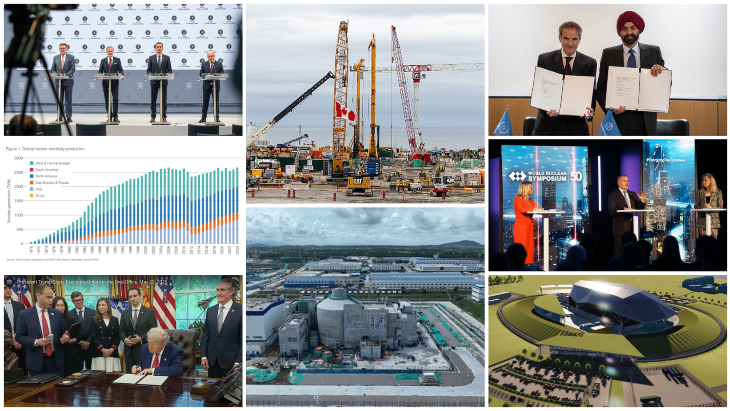
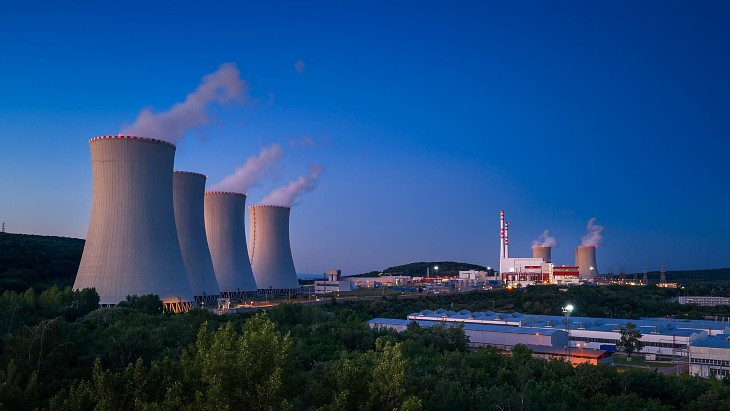
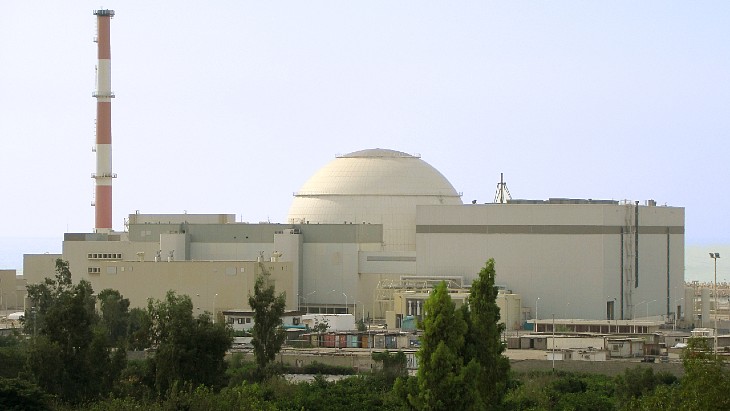
Images from eight of the most popular articles this year (Image: Various/WNN)
April
The World Nuclear Fuel Cycle conference was held in Canada, and A guide: Uranium and the nuclear fuel cycle was the month’s third most-read article. But it was never going to pip the news that the Canadian Nuclear Safety Commission had authorised Ontario Power Generation to construct a BWRX-300 reactor at the Darlington New Nuclear Project site, the first SMR in a G7 country. Other popular developments included ten new reactors being approved in China and the second Pakistani Hualong One unit - Karachi 3 - passing its final acceptance. The long-running contest to select a technology, or technologies, for the UK’s first official small modular reactor project, was also approaching its crunch stage.
May
May saw continuing interest in the Canadian SMR project, with the article about the Province of Ontario giving OPG the go-head to start construction second only during the month to our article setting out in detail how the CAD20.9 billion budget had been calculated. There was also a Canadian element to the third best read story of the month - the news that China’s Qunshan III unit 1 had set a new record for the longest uninterrupted operation of a power reactor in China as well as setting a world record for an operating run - 738 days - for a Candu-6 reactor. In the USA, President Donald Trump signed a series of executive orders with the goal of "re-establishing the United States as the global leader in nuclear energy". Also popular was the news that India's nuclear regulator had given its consent to the siting of the four-unit Mahi Banswara Rajasthan Atomic Power Project in Rajasthan. And World Nuclear Association's inaugural World Nuclear Supply Chain conference heard how Poland's supply chain was gearing up for its first nuclear project.
June
The big news story in June was that, after a process which lasted a few years, Rolls-Royce SMR had been selected by the UK as the preferred technology for its first government-backed small modular reactor project. Staying with small reactors producing large amounts of interest, there was the launch of the lead-cooled Eagles-300 SMR project by four European nuclear technology organisations. The month saw the signing by Korea Hydro & Nuclear Power of the contract for new nuclear at Dukovany in the Czech Republic, after legal obstacles were cleared. And one of the most significant, and most read, articles was the news that the World Bank had officially ended its long standing ban on financing new nuclear energy projects. Maybe of particular interest to our 156,000 Facebook followers was the news that Meta had signed a 20-year power purchase agreement with Constellation for the output of the Clinton Clean Energy Centre's boiling water reactor's output from 2027.
July
The mood about nuclear energy in the USA continued to be bullish in July, with Westinghouse announcing plans to start the construction of the first of 10 new AP1000 reactors in the US by 2030. Holtec submitted a letter to the US Nuclear Regulatory Commission as it aimed to transition Palisades from decommissioning to operational status. In the UK, the first steam generator was lowered into place at Hinkley Point C; China produced its first barrel of natural uranium from its largest domestic project - the National Uranium No.1 demonstration project - in Ordos in the Inner Mongolia Autonomous Region; a report from the OECD Nuclear Energy Agency identified 127 SMR designs across the world; and in Bangladesh hot testing of Rooppur unit 1 got under way.
August
The most read in August was the news that Poland's Orlen and Synthos Green Energy had selected Włocławek as the site for the country's first SMR. Staying in Europe, an exploratory borehole had been drilled as part of efforts to retrieve radioactive waste from the Asse II mine in Germany. In the USA, the Department of Energy selected 11 advanced reactor projects for a programme which aims to see at least three of them achieve criticality by 4 July 2026. Rolls-Royce SMR's signing of an MoU with Czech firm Škoda JS and a strategic partnership with Curtiss-Wright's UK-based nuclear business proved popular. The month also saw Newcleo announcing it was winding down its UK activities.
September
The month began with World Nuclear Performance Report 2025 being published, including the historic news that 2024 had set a new record for nuclear electricity generation. That was a perfect way to kick-start the 50th World Nuclear Symposium in London. To mark the occasion WNN produced a commemorative history of the event. There was also a look at the key takeaways from this year's event. In the USA, Oklo held a ground-breaking ceremony at Idaho National Laboratory for the Aurora-INL sodium-cooled fast reactor. Fusion made it into the most-read list for September courtesy of First Light Fusion, while we learned that Uranium Energy Corp had launched a new subsidiary to pursue the feasibility of developing a new US uranium refining and conversion facility.
But the most-read article was our report from an event at the IAEA General Conference which set out in detail the damage to Chernobyl's giant shelter, and experts' views that it might not ever be possible to restore it to its full original design purposes.
October
The Philippines government set out its plan for nuclear new-build - it aims to have its first nuclear power plant operational by 2032. The second most read article of the month was the completion of cold testing at China's first SMR, the ACP100/Linglong One. Eight years after construction was halted on two AP1000s at VC Summer in the USA, Santee Cooper selected Brookfield Asset Management for the potential completion of the units. It was a good month for pictures, with Amazon giving an update on its SMR progress, with new images of its proposed plant, and a picture gallery of the giant cryostat for ITER's magnet cold test facility arriving in southern France. There was also nuclear fuel news with four companies being selected by the US Department of Energy for its pilot programme to build advanced nuclear fuel lines.
November
The clear frontrunner for the month was the news that the experimental TMSR-LF1 thorium-powered molten salt reactor in Wuwei, Gansu Province, had achieved the first successful conversion of thorium-uranium nuclear fuel, according to the Shanghai Institute of Applied Physics of the Chinese Academy of Sciences. Also popular was the start of building work for TRISO-X’s TX-1 advanced nuclear fuel fabrication facility in Oak Ridge, Tennessee, and Russia and India discussing potential new nuclear energy projects. In the UK, the Sizewell C project reached Financial Close, three months after the government signed the final investment decision on the twin EPRs project. In the US Constellation said it was exploring doubling capacity at Calvert Cliffs. In Ukraine the first decontaminated steel from Chernobyl was released for reuse. South Africa's Koeberg 2 was approved for extended operation and in Sweden the pro-nuclear mood continued with the Swedish parliament voting to allow uranium mining.
December
With just a few days to go to the end of the year, the most read articles of the month have been, in order: The US Department of Energy selecting Tennessee Valley Authority and Holtec to each receive USD400 million in federal cost-shared funding to support early deployments of advanced light-water small modular reactors in the USA; Samsung Heavy Industries receiving Approval in Principle from the American Bureau of Shipping for a floating marine nuclear power platform featuring two SMART100 SMRs developed by the Korea Atomic Energy Research Institute; Belgium shutting Doel 2 after 50 years of operation - the fifth to go as part of the country's nuclear phase-out policy; GE Vernova Hitachi's BWRX-300 design clearing Step 2 of the UK's Generic Design Assessment; and news from Idaho National Laboratory that it had launched full-scale production of enriched fuel salt for the world's first test of a molten chloride salt fast reactor.
Over the whole year, the most read were:
Canada's first SMR project: How is CAD20.9 billion cost calculated?
OPG says goodbye to Pickering 4
Chinese molten salt reactor achieves conversion of thorium-uranium fuel
Chernobyl shelter repairs: 'Difficult choices' lie ahead
Mars in 30 days? Russia unveils prototype of plasma rocket engine


_33474.jpg)
_37830.jpg)