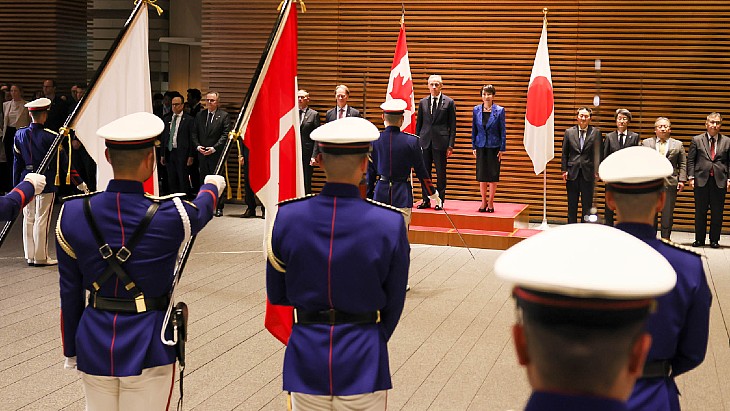
Details of the bilateral strategic agreement and roadmap were outlined during a visit to Japan by Canada's Prime Minister Mark Carney (see picture above).
The roadmap says that "recognising the importance of energy security and food security in an era of heightened geopolitical uncertainty" the two countries will "enhance cooperation on clean energy technologies, including nuclear technologies, (particularly small modular reactors), hydrogen and its derivatives, carbon capture, utilisation, and storage, renewables, and energy-efficient industrial processes".
Carney said: "Japan is a trusted partner and a global leader in innovation, technology, and advanced manufacturing. Together, we are strengthening our economic security, securing resilient supply chains in critical minerals and clean energy, and deepening security and defence cooperation in support of a free and open Indo-Pacific."
Japanese Prime Minister Sanae Takaichi said: "Canada is an important partner for Japan in advancing cooperation in the field of economic security ... Canada’s abundant natural resources and Japan’s technological capabilities are complementary, and concrete projects involving companies from both countries are steadily progressing. For example, production at LNG Canada, which is of great significance for Japan’s energy security, began last year, and construction of a small modular reactor - the first of its kind in the G7 - also began in Ontario. In addition, projects related to critical minerals such as graphite are under way."
In their joint statement the two leaders said "we believe the new Comprehensive Strategic Roadmap will serve as an effective guide for ongoing collaboration, enhancing our joint resilience in the face of new challenges and opportunities".
About 15% of Canada's electricity comes from nuclear power, with 17 reactors, mostly in Ontario, providing 12.7 GWe of power capacity. It also has plans to build both new large-scale nuclear capacity and small modular reactors. Japan has 33 operable reactors with a capacity of 31.7 GWe. Of these, 15 reactors have restarted since 2011 and 10 are currently in the process of restart approval. The country's current goal is, with more reactor restarts, for nuclear to generate 20% of Japan's electricity by 2030.


_81351.jpg)
_76441.jpg)
_28347.jpg)
_84289_33276.jpg)

_85344.jpg)