The BRL50 million (USD9.1 million) microreactor project brings together private and public sector bodies to develop a concept for a 5 MWt microreactor with core cooling by heat pipes.
The project, which began in 2025 and is expected to last three years, involves 13 partners and will test and develop technology applicable to microreactors, with the goal of constructing a prototype of a Brazilian microreactor at the Nuclear Engineering Institute of the National Nuclear Energy Commission (CNEN), in Rio de Janeiro.
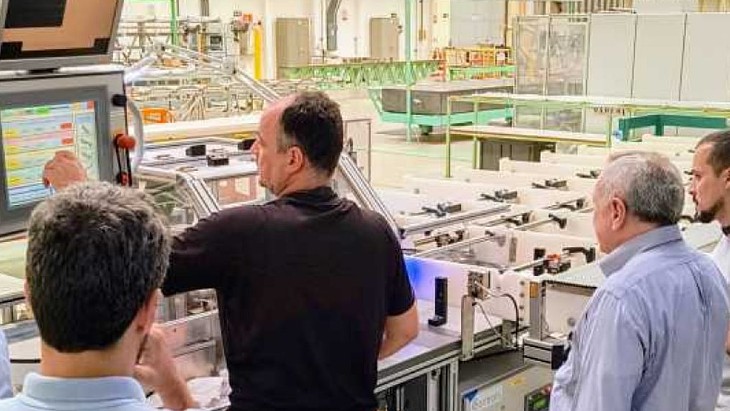
Once the fuel rod tests, which began in January, are completed, the production processes will undergo qualification to validate and document the manufacturing methods. As well as Indústrias Nucleares do Brasil (INB), representatives from Diamante Energia and Terminus Energia monitored the production and quality control stages of the test rods.
INB metallurgical engineer Franklin Palheiros said "these tests allow us to anticipate adjustments before the start of production, scheduled for 2027", when the plan is to then supply the prototype where technology experiments will be conducted.
Terminus Energia's Adolfo Braid said: "INB is the only nuclear fuel manufacturer in Brazil with licensed technology, and its participation is fundamental to the programme's success. Without this partnership, the project simply wouldn't exist."
The CNEN project aims to demonstrate the feasibility of the development of a Brazilian 3-5 MW microreactor. The vision is for the microreactor to fit within a 40-foot container and be operated remotely for more than 10 years without any need for refuelling. INB is responsible for supplying nuclear fuel and specialised engineering services, as well as providing technical and administrative support.
At the end of the three-year project it is proposed to demonstrate the main technologies planned, as well as seeking the first regulatory authorisations from Brazil's regulators.
Suggested future uses for the microreactor include providing reliable power to remote towns, to hospitals and factories and reducing dependency on diesel generators.
There are various microreactor projects at different stages of development around the world. While small modular reactors are generally seen as including reactors up to 300 MW, microreactors are said by the International Atomic Energy Agency to be those designed for up to about 20 MW, with container-based ones seen as having the ability to be transported to a wide range of potential locations, including isolated areas.
Brazil currently has two operating power reactors - Angra 1 and Angra 2 - which generate about 3% of the country’s electricity.


_33474.jpg)
_37830.jpg)
_85344.jpg)