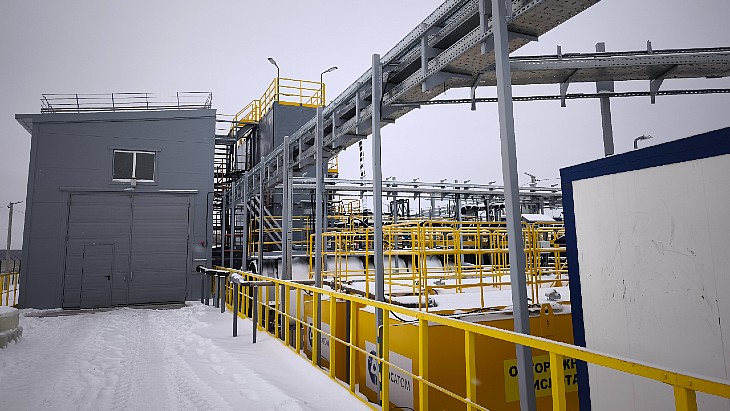
The mobile sorption unit, installed by Rosatom mining division company JSC Dalur, consists of container-type modules including mobile sorption columns, solution and sorbent tanks and an electrical substation and control room.
It can be relocated between sites rapidly and is focused on remote areas, with Rosatom saying its main advantages are "mobility, rapid commissioning, and a significant reduction in capital expenditures compared with traditional stationary facilities".
Dalur was the first company in Russia to mine uranium using the in-situ recovery (ISR) method - also known as in-situ leaching (ISL). It involves minerals being recovered from ore in the ground by dissolving them in situ, using a mining solution injected into the orebody.
The solution is then pumped to the surface, where the minerals are recovered from the uranium-bearing solution. More than half of the world's uranium production is now produced by such methods.
Rosatom described it as the most environmentally-friendly mining method and said it had been developed by Dalur in collaboration with other mining division companies - it was tested at the deposits of JSC Khiagda, in the Republic of Buryatia.
Dinis Ezhurov, CEO of JSC Dalur, said: "We are optimising mining processes by maximising startup, eliminating time-consuming and costly stages of design documentation preparation and the construction of expensive deep foundations. This not only improves production and economic performance but also sets modern standards for uranium mining using the in-situ leaching method."
Dalur is currently in the process of commissioning the new uranium deposit, "testing the facility, connecting the wells and constructing associated infrastructure", and aims to begin mining in the first half of 2026.


_55567.jpg)
_51646.jpg)
_33474.jpg)
_37830.jpg)
_85344.jpg)