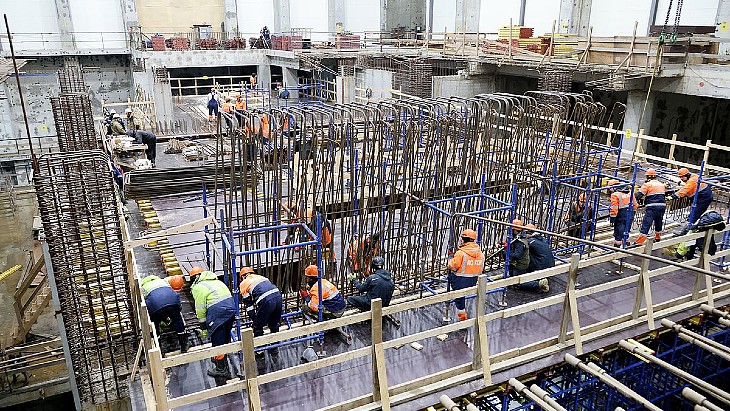
The foundation will be constructed using 36 spring elements, which will reduce the vibration load from the operating turbine unit on the foundation columns and adjacent process equipment. It is designed to withstand severe earthquakes.
Concreting of the foundation will take place in three stages, with a total volume poured of more than 620 cubic metres and reinforcement and embedded parts exceeding 100 tonnes. It will be left undisturbed for several months before the turbine unit is installed, and some embedded parts will be included to monitor any possible foundation movement during operation.
Ivan Babich, a representative of the project's management at JSC SCC, said: "Concreting such a critical component is a long and labour-intensive process. But for equipment weighing over 1,700 tonnes, stable support is not just important, but critical."
The turbine and generator were delivered to the site at the end of last year.
Meanwhile, endurance testing of the prototype main circulation pump unit for the BREST-OD-300 reactor is ongoing - the unit will pump 11 tonnes of molten lead per second at a temperature exceeding 420 degrees Celsius.
The background
The BREST-OD-300 fast reactor is part of Rosatom's Proryv, or Breakthrough, project to enable a closed nuclear fuel cycle. The 300 MWe unit will be the main facility of the Pilot Demonstration Energy Complex at the Siberian Chemical Combine site. The complex will demonstrate an on-site closed nuclear fuel cycle with a facility for the fabrication/re-fabrication of mixed uranium-plutonium nitride nuclear fuel, as well as a used fuel reprocessing facility.
Recent progress updates included the news in October that the last roofing truss had been moved into place on the turbine hall and the metal shell for the central cavity - which weighs 143 tonnes and is more than 14 metres tall with a diameter of 8 metres - had been installed in place. The four perpheral cavity shells were all installed during December.
Initial operation of the demonstration unit will be focused on performance and after 10 years or so it will be commercially oriented. The plan has been that if it is successful as a 300 MWe (700 MWt) unit, a 1,200 MWe (2,800 MWt) version will follow - the BR-1200.


_55567.jpg)
_51646.jpg)
_33474.jpg)
_85344.jpg)