The new president of Argentina's National Atomic Energy Commission (CNEA), Martin Porro, and Secretary of Nuclear Affairs Federico Ramos Napoli, set out progress while hosting a tour for Argentina's ambassador to the USA - and tech business entrepreneur - Alec Oxenford.
The RA-10 multipurpose reactor is a 30 MWt open pool type reactor. The aim is for its commissioning to begin during 2026, with full operation in 2027.
Engineer Pablo Cantero, area manager of the RA-10 project, said: "Currently, 580 people are working on the project. This year's achievements include the installation of the water supply plant, the completion of the general assembly and the control room, and the start of pre-operational testing."
CNEA says the reactor is "designed to guarantee the national self-sufficiency of radioisotopes for medical diagnoses and treatments, such as molybdenum-99, iridium-192, and lutetium-177, which are also in high demand internationally. Argentina will become one of the leading exporters of these radioisotopes".
As well as producing radioisotopes for export it also aims to develop new radioisotope production and produce high quality doped silicon for high power electronics applications. It will also be able to test nuclear fuel and have facilities to be able to test materials such as radiation damage in nuclear power plants' reactor pressure vessels.
The RA-10 project was approved by the government and officially started by CNEA in June 2010. Argentina's Nuclear Regulatory Authority granted a construction licence for RA-10 in November 2014. The civil works for the reactor began in 2016. Nuclear technology firm Invap is involved in the design and construction of the reactor facility and related installations, playing the role of main contractor.
The assembly of the RA-10 pool - which will house the core of the reactor - was completed in August 2018. The RA-10 will replace the RA-3 reactor on the same site, a 10 MWt pool-type reactor which began operations in 1967. The RA-10 will also have associated facilities such as the Argentine Neutron Beam Laboratory and the Laboratory for the Study of Irradiated Materials.
Progress in Brazil
Meanwhile, in neighbouring Brazil, the aim is for construction of the Brazilian Multipurpose Reactor (RMB) to begin in the first half of 2026, according to the National Nuclear Energy Commission (CNEN).
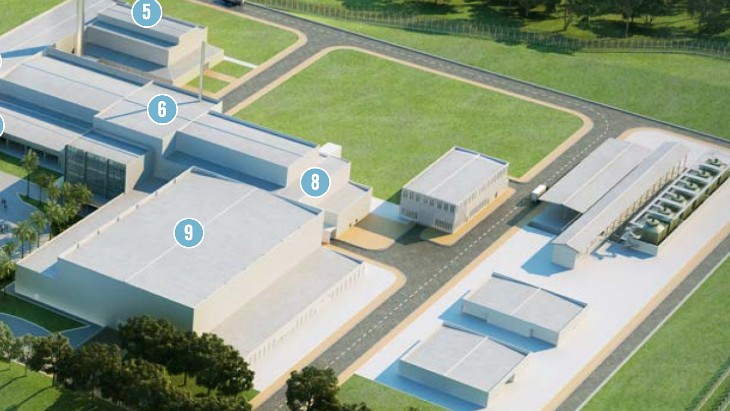
How the RMB centre might look, with the reactor building (8) and Neutron Beam Laboratory (9) (Image: CNEN)
The President of CNEN, Francisco Rondinelli, has been in Argentina holding meetings with Invap "focusing on establishing the basic terms of the engineering contract that will enable the new construction phase of the project".
The RMB is similar to Argentina's RA-10 multipurpose reactor. It has been in development since 2008. Invap signed an agreement in 2013 to build the two research reactors - one in each country - with the reference design to be the Open Pool Australian Light-water (Opal) research reactor that Invap supplied to the Australian Nuclear Science & Technology Organisation. At the time it was estimated that between them, the two new reactors would provide capacity to supply 40% of the world's isotope demand.
The Brazilian multipurpose reactor is to be part of a two-million-square-metre site which, it is proposed, will also host laboratories for researching nuclear fusion, particle accelerators and radiopharmaceutical development and production. Infrastructure work on the site began in February and the total project cost has been estimated at USD500 million, with a target completion date of 2030.


_33474.jpg)
_37830.jpg)
_85344.jpg)