_94492.jpg)
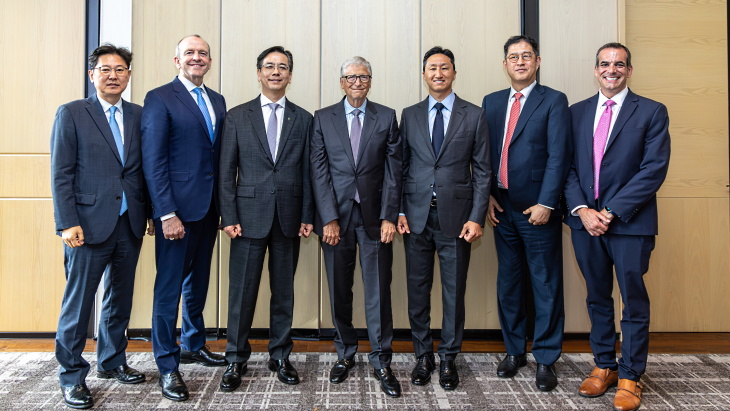
The application was handed to Johan Britz, Minister for Employment and acting Minister for Climate and the Environment, by Studsvik's President and CEO Karl Thedéen and Christian Sjölander, Head of New-Build Projects. The application concerns the construction of two to four light water-cooled and light water-moderated nuclear reactors with a combined capacity of between 600 MWe and 1,400 MWe. Subject to permits, the company is aiming for commercial operation of the first reactors in the 2030s.
"Sweden has decided to build new nuclear power, and the country needs new firm, fossil-free capacity on a scale not seen in a generation," Thedéen said. "Few sites in the country are as ready to contribute as Nyköping. Studsvik combines an active nuclear site and decades of technical expertise with one of Sweden's most experienced new-build development teams. Our intention is to turn that into real capacity for the Swedish grid."
Studsvik has previously said its Nyköping site is in a strategic location and houses the company's broad expertise in nuclear technology, including fuel and materials technology, reactor analysis software and fuel optimisation, decommissioning and radiation protection services as well as technical solutions for handling, conditioning and volume reduction of radioactive waste.
Sjölander added: "The application is the start of a permitting process. Our task now is to do the technical, environmental and community work needed to build confidence among the municipality, the authorities and our neighbours that this is a project worth backing - and to keep that dialogue going at every stage."
The government review is the first stage of an extensive permitting process that will also involve the municipality, the Land and Environment Court and the Swedish Radiation Safety Authority. Any future establishment would require further reviews, permits and approvals under Swedish nuclear, environmental and planning legislation, alongside continued local engagement.
Nyköping Municipality noted that it has not currently taken a position on the possible construction of the plant. "The issue will be examined within the framework of the formal permit process that applies to nuclear facilities in Sweden," it said. "According to the legislation, the municipality has a so-called veto right and can say 'yes' or 'no' to the establishment. In order for the establishment to be carried out, the municipality must say 'yes'. The issue is decided by the municipal council and handled at an early stage of the process."
The Nyköping project would be part of Studsvik's ReFirm SMR programme - which came into the group with the acquisition of Kärnfull Next earlier this year - aiming to expand carbon-free and dispatchable energy production across southern Sweden. ReFirm is also pursuing projects at Valdemarsvik, Motala and Karlshamn.
In February, the Swedish government announced several proposed measures to make it easier to establish new nuclear power in the country. The new legislation introduced an early-stage government approval process designed to improve predictability and accelerate the deployment of new nuclear capacity. The following month, Kärnfull Next submitted an application to build a 1,200–1,600 MWe power plant based on SMRs in the municipality of Valdemarsvik in Östergötland county in southeastern Sweden, becoming the first application under the country's new Act on Government Approval of Nuclear Facilities. It marked the first application for the establishment of new nuclear power in Sweden in 50 years.
"Further applications may follow as the group's project portfolio matures," Studsvik said.
Earlier this month, Swedish lead-cooled small modular reactor technology developer Blykalla submitted an application to the government to construct a power plant in Norrsundet, Gävle, in east central Sweden, comprising six SEALER reactors.
"Developments for a new start of Swedish nuclear power and an effective climate transition are now proceeding rapidly," said Acting Minister of Climate and Environment Johan Britz. "The fact that the government has now received another application for new nuclear power clearly shows that the legislative changes that the government has implemented create the right conditions for companies to want to invest in new nuclear power."


_55567.jpg)
_51646.jpg)
_33474.jpg)
_85344.jpg)