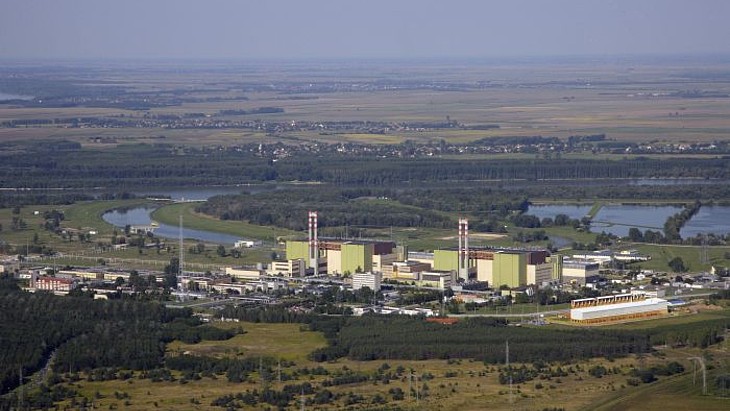
According to Magyar Villamos Művek (MVM), the Hungarian operator, the water level in the Danube is now 28 centimetres below the previous record, set in 2018, which was itself one metre below the 100-year minimum water level used in the design of Paks nuclear power plant, which opened in the early 1980s.
It has already been reducing the total plant's output and stressed that there was no safety issue, but said that "although the current extremely low water level and water flow rate would allow sufficient water to cool the units, the suction level of the pumps required for this is higher than the current low - and expected to continue to decrease - water level, so they cannot perform their task".
"Of course, the nuclear power plant is prepared for extraordinary situations, including those with a low probability of occurrence. We have developed procedures for dealing with the so-called low water situation of the Danube. Low water conditions are divided into 4 stages based on the levels measured at the water intake … we are currently in stage 3.
"According to forecasts, there is a realistic chance of a level 4 event: at this point, all units of the nuclear power plant will have to be shut down, energy production will cease from then on, and the units will have to be cooled. This requires 5 cubic metres of water per minute, compared with 100 cubic metres per second for the operating units.
"We can currently give an estimate for the complete shutdown - due to water forecasts that change several times a day: according to our calculations, the time frame within which we must implement the shutdown is 24-72 hours."
MVM added that it has pumps on standby and in reserve if required and the plant "is prepared to handle the extraordinary situation of a complete shutdown: we keep the units in a safe condition even in the event of extremely low water levels lasting for weeks, and when the appropriate water level is reached, we immediately start the production of the units in stages, based on the strict rules. Depending on the water level, the units can be restarted in a few days".
It says the record-low water level in the Danube is a combination of climate change - "In previous years, there were so-called high waters several times a year - this year, the water level has been low all year round" - and deepening of the river bed.
It also outlined measures being taken to tackle such situations in the future - with preparatory work to lower the intake pipes already taking place "and within a few years the nuclear power plant will be able to continue production even with a lower water level than the current one".
The Paks plant, 100 kilometres south of Budapest, currently comprises four Russian-supplied VVER-440 pressurised water reactors, which started up between 1982 and 1987 and generate about half the country's electricity. Construction work has also begun on the first of two new VVER-1200 reactors planned at the neighbouring Paks II site.
Romania
In neighbouring Romania, Nuclearelectrica announced on Monday that Cernavoda unit 1 was being shut down and disconnected from the National Energy System "due to the unprecedentedly low level of the Danube, caused by severe drought".
It said the shutdown followed the latest forecasts issued by the National Institute of Hydrology and Water Management and said "such measures have a preventive role and aim to protect nuclear safety and the reliability of the facilities" and "has no impact on nuclear safety, personnel or the environment".
On Wednesday it was announced that the second unit was also likely to be shut down but on Thursday there was a further update announcing that unit 2 would remain online because "analysis of the operating parameters and equipment of unit 2 carried out by the specialists of Cernavoda NPP on the night of 29 to 30 July 2026, found that the operating parameters allow the continued operation of unit 2 in safe conditions".
"Nuclearelectrica is making every possible effort to continue the operation in conditions of maximum safety and to contribute to the stability of the National Energy System."
However, it added: "Considering both the current situation and the hydrological forecasts regarding the level of the Danube, the shutdown of unit 2 may be necessary at any time."
Cernavoda is the only nuclear power plant in Romania and consists of two 650 MWe Candu reactors, generating about a fifth of its electricity. Unit 1 went into commercial operation in 1996 and unit 2 in 2007.
Elsewhere
The impact of the heatwave is being felt across most European countries. These have had an impact on a range of industries and have also led to mass evacuations of residents and holidaymakers as a result of wildfires in countries including Spain and France.
In Bulgaria, a special task force has been established at Kozloduy Nuclear Power Plant to manage the situation, and "includes all necessary measures to ensure the safe and reliable operation of the plant's power units during a prolonged drop in river levels" in the Danube. The plant operators say that "currently, the operating load of the two units of Kozloduy Nuclear Power Plant is in accordance with the power generation schedule".
In France, nuclear operator EDF has temporarily taken Bugey unit 3, Chooz unit 2 and Golfech 2 - located on the banks of the Rhône, Meuse and Garonne rivers, respectively - offline to comply with regulations on cooling water discharges. Eight other reactors are operating at reduced power. These are: Saint Alban units 1 and 2; Bugey units 4 and 5; Blayais units 1 and 3; and Tricastin. The measure is an environmental protection requirement to avoid discharging too much hot water into rivers already warming from the heatwave. In Switzerland the two units at Beznau have also had to be temporarily shut down, or operated at lower power over recent weeks due to high temperatures in the River Aare.


_51646.jpg)
_33474.jpg)
_37830.jpg)
_75866.jpg)
_85344.jpg)