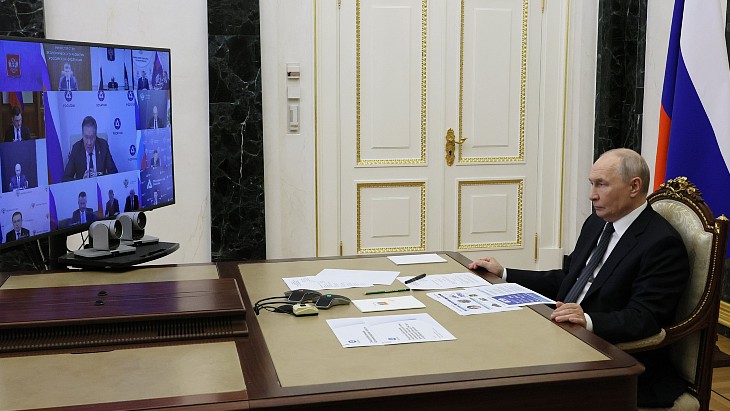
In the Kremlin's official report on a virtual meeting held to discuss the development of nuclear energy, he said Russia was "probably the only country in the world that possesses expertise across the entire nuclear energy chain" with that "competitive advantage" leading to growth of its exports.
He said, domestically, "Russia plans to commission approximately 30 gigawatts of additional nuclear power capacity, including small nuclear power plants. This will not only replace power units that are gradually reaching the end of their service life but also significantly increase the overall capacity of domestic nuclear generation".
He said that the plans to "expand the geographic distribution of power units" will help "strengthen the infrastructure base for the long-term development of regions and territories, for the emergence of new energy-intensive industries, including those focused on the advanced processing of natural resources in the Arctic, Siberia, and the Far East".
In his remarks, the president referred to the need "to ensure technological readiness for the design and construction of nuclear power plants - both large and small - and to have a line of standard power units that can be assembled in series, on a conveyor belt".
He said there must be enough fuel for the expanded capacity so "we must work to strengthen our own resource base, conduct geological exploration, and develop deposits", as well as ensuring the widespread adoption of a closed nuclear fuel cycle.
And his final point was on finance - "successful implementation of nuclear energy plans requires a sustainable financial model for the industry's development. It must take into account the specifics of investment project financing, the scale of investment, payback periods, and so on".
Export goals
According to the Kremlin report of the meeting, Alexei Likhachev, Director General of Russia's state nuclear corporation, Rosatom, outlined the current plans for new capacity.
He said that there were currently 34 operating units at 11 nuclear plants, with his figures including the six units at the Zaporizhzhia Nuclear Power Plant, which has been under Russian military control since March 2022. He noted that over the next 10 years, some 13 units, accounting for 10 GW of capacity, are due to be decommissioned.
Under Russia's 2024 General Plan for the Location of Nuclear Power Facilities, by 2042 there will be 38 new nuclear power units built - including GW-scale, VVER-600 medium-sized units and small modular reactors (SMRs), and the share of nuclear generation will rise from 20% to 25% by 2045. He reported that "as of today, we have already reached nine sites. In total, including small and floating nuclear power plants, 18 power units are under construction in Russia".
On the international front, 28 units are currently being built in nine countries - India, China, Turkey, Egypt, Iran, Bangladesh, Hungary, Uzbekistan and Kazakhstan, where "we have nearly completed surveys at the site where the two VVER-1200 units will be located".
"We are working to further expand our international presence and already have signed agreements for the construction of 17 more power units in six countries. The latest example is the signing of a corresponding intergovernmental agreement with Vietnam. We are also negotiating with 15 more countries. We are aiming for approximately 50 potential individual reactors under these agreements," Likhachev added.
Regulations
The Rosatom director general also said that regulation was a "significant factor in ensuring and developing our leadership", and thanked the country's regulator Rostekhnadzor for its "collaboration and for its significant support in promoting our international projects". He added, however, that technology was "advancing somewhat faster than the updating of standards and the technical regulation system itself".
He said: "In our view, the time has come to update federal regulations and rules for promising developments to ensure the regulation of new technologies, naturally, without any safety risks. A number of countries are already implementing early project assessment, whereby the regulator works with the developer well before the licensing application is submitted, resolving any disputes at this stage, rather than during construction or project implementation.
"I think we should take advantage of the best practices, including global ones, without, of course, weakening the independence of oversight or creating any risks to security."
Likhachev also referred to the country's nuclear fusion plans, saying that "together with the Kurchatov Institute, we are preparing to begin developing a unique tokamak using reactor technology".


_51646.jpg)
_33474.jpg)
_37830.jpg)
_75866.jpg)
_85344.jpg)