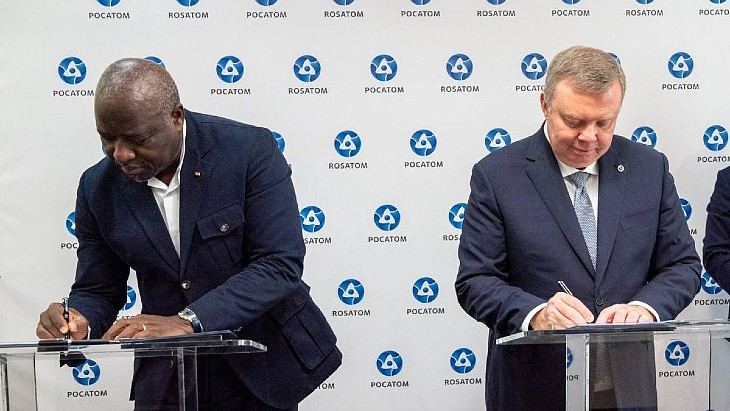
The meeting, co-chaired by Rosatom Deputy Director General Kirill Komarov and Lassina Zerbo, Chairman of the Rwanda Atomic Energy Board and advisor to Rwanda's president, pictured above signing the agreement, took place in Moscow.
Komarov said: "We are moving from framework agreements to joint work on concrete tracks: from training national personnel and developing nuclear infrastructure to projects in nuclear science and small modular reactors. Rwanda is building its nuclear programme consistently and responsibly, and Rosatom is ready to be a reliable partner for the country at every stage of this journey."
Zerbo said: "The roadmap agreed upon today is building on the bilateral cooperation in the peaceful uses of nuclear energy initiated in 2018. Our priority is to include nuclear power within our energy mix by early 2030s to address the growing energy demand in Rwanda. Implementing a nuclear energy programme is first and foremost an investment in people, in science and in the country's long-term development. The Joint Coordinating Committee allows us to move to substantive work across every track of our programme."
Rwanda has been developing plans to adopt nuclear energy for a number of years, with President Kagame saying at the Nuclear Energy Conference in Paris in March that it plans to have its first small modular reactor operational in the early-2030s.
He said at that conference: "Nuclear energy is not too complex or risky for developing countries. The standards developed by the IAEA provide a universal framework that can be applied by countries at every income level ... nuclear technology is evolving in ways that benefit countries with small grids, allowing Africa to be among the early adopters. Small modular reactors in particular are especially suited to Africa's requirements."
Rwanda and Russia signed an intergovernmental agreement on cooperation in the peaceful uses of nuclear energy in 2018. The following year an agreement was signed on the construction of a Centre for Nuclear Science and Technology in Rwanda, which is to include a 10 MW research reactor and a set of laboratories.
Rwanda is also exploring a number of other options for future nuclear - earlier this year Holtec International and the Rwanda Atomic Energy Board signed a development agreement to explore the potential deployment of up to 5 GW capacity of SMR-300 units.


_33474.jpg)
_37830.jpg)
_85344.jpg)