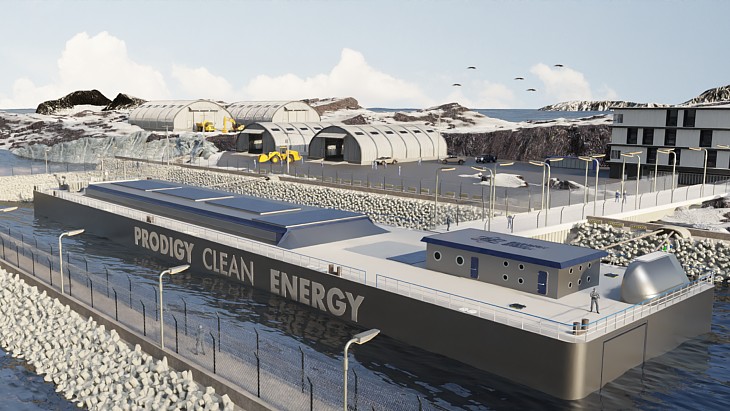
Prodigy aims to combine "proven nuclear technologies with maritime factory fabrication, transport and construction practices, to deliver a fully-assembled nuclear plant, that meets Canadian regulatory requirements, to site. Upon arrival, the plant is fixed in place within a protected enclosure at the shoreline, either in a marine harbour or on land. Fueling and final commissioning are completed at the site before beginning power generation".
It says that its Transportable Nuclear Power Plant (TNPP) tech can be used to deploy reactors of various sizes and types and that they are particularly well suited to remote areas.
Tim Hodgson, Minister of Energy and Natural Resources, said: "To become a clean energy superpower, we need to deploy affordable, reliable, clean Canadian energy from coast to coast to coast - especially in rural, northern and remote regions, where there can be fewer options for families. By advancing promising Canadian technologies such as Prodigy's, we are supporting economic growth in the North while strengthening Canada’s energy security."
The design for remote deployment used a TRISO-fuelled microreactor, and Prodigy worked with Kinectrics, Lloyd's Register, Serco, C-Job Naval Architects and Risktec during the research and development work. Siting assessments at potential deployment locations were carried out with Indigenous Rights Holders.
Montreal-based Prodigy is developing two sizes of facilities: the Prodigy Microreactor Power Station TNPP and the SMR Marine Power Station TNPP, which can integrate different sizes and types of nuclear reactors. Prodigy says its Transportable Nuclear Power Plants are not barges with reactors onboard - they are purpose-designed, marine-fabricated buildings qualified to house operating nuclear reactors. All systems and components are contained within the plant, reducing the need for additional land-based buildings. They are customisable from 1-1000 MWe gross output, and can be tailored for high-heat applications.
Mathias Trojer, President and CEO, Prodigy Clean Energy, said: "Prodigy's TNPPs are technological solutions that improve SMR build standardisation, manufacturing and deployment efficiency, and geographical reach - they will become effective tools to increase Arctic energy security. Early leadership in TNPPs has strengthened Canada’s global competitive edge in nuclear energy."
Lori-Anne Ramsay, Chief Business Development Officer, Prodigy, said the importance of the research and development (R&D) work was that "there is limited global precedent in how to design transportable nuclear facilities generally, and specifically, for commercial deployment in the Arctic" and the R&D programme "identified the critical issues for this deployment scenario and implemented design and engineering solutions for this end use, while ensuring meeting regulatory requirements of the Canadian Nuclear Safety Commission and optimising commercial viability".
She added: "For example, we developed a bounding envelope representative of the majority of Northern and Arctic environments, and designed the TNPP to be resilient to these sets of remote conditions, while guaranteeing safe and secure operation of the nuclear systems with minimal effects on the environment, and also maintaining cost effectiveness. R&D further completed prototypical testing, demonstrating that the TNPP can protect, deter, and deny, resisting both threats and accident scenarios."
The goal has been to achieve licensing and deployment for an energy project in Canada between 2030 and 2032, and Ramsay said a First Nation in Canada has proposed a TNPP pilot project. Next steps are to complete an integrated TNPP design using the selected small modular reactor, and to tailor the site-based infrastructure for the deployment location. "The pilot will generate commercially-available electricity, validating the TNPP and its operational requirements, so that we can scale the technology for fleet deployment," she said.


_55567.jpg)
_51646.jpg)
_33474.jpg)
_85344.jpg)