A drone strike on Sunday morning caused a fire in an electrical generator located outside the inner perimeter of the plant in the United Arab Emirates. Emergency diesel generators were required to provide power to Barakah's unit 3 until sufficient off-site power was restored, he said. Radiation levels remained normal at all times and no injuries were reported.
The UAE has said its investigations have found that the drone, plus others which were successfully intercepted, had originated from Iraqi territory.
Grossi said he had been in contact with leaders "throughout the Gulf region and I can see the unease and great concern. I have been discussing how the IAEA can offer further assistance. Since last year, the IAEA has been gathering information, as well as analysing and evaluating emergency preparedness and response capacities. I will be travelling to the Gulf soon to continue this important joint work.
"The IAEA will continue providing guidance and training to competent authorities and first responders in areas including: radiological impact, emergency protective measures for the public and workers, international emergency arrangements, emergency response plans, and provision of equipment and services to support emergency response. We stand ready, if necessary, to deploy the Agency's nuclear safety and security experts to support nuclear safety efforts on the ground."
The IAEA, which is a United Nations agency, has an Incident and Emergency Centre at its headquarters in Vienna, Austria, which is operating 24/7.
He said: "The situation is of grave concern. This is a nuclear site in the Middle East where the consequences of an attack could be most serious. It is an operating nuclear power plant, and as such, it hosts thousands of kilograms of nuclear material in the core of the reactors, fresh and spent fuel. I want to make it absolutely and completely clear: In case of an attack on the Barakah Nuclear Power Plant, a direct hit could result in a very high release of radioactivity to the environment.
"A hit that disabled the lines supplying electrical power to the plant could increase the likelihood of its reactors' cores melting, which could result in a high release of radioactivity. In their worst cases, both scenarios would necessitate protective actions, such as evacuations and sheltering of the population or the need to take stable iodine, with the reach extending to distances from a few to several hundred kilometres. Radiation monitoring would need to cover distances of several hundred kilometres and food restrictions may need to be implemented."
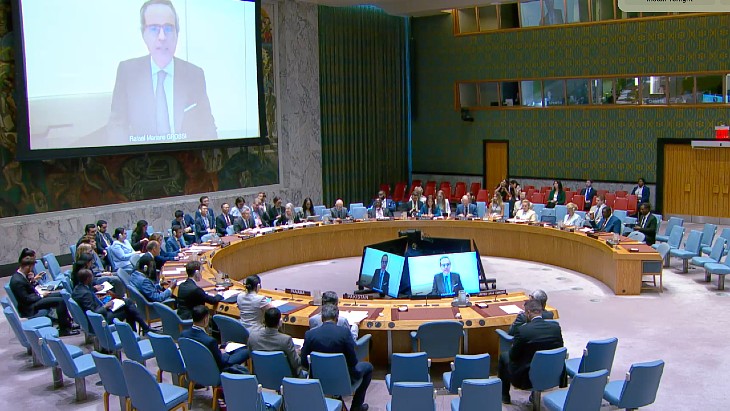
Grossi, speaking by video link to the United Nations Security Council members in New York in the USA, added: "Attacks on nuclear facilities devoted to peaceful purposes are unacceptable. This is consistent with the IAEA General Conference's resolutions. Attacks are even more dangerous when they are against operating nuclear power plants like Zaporizhzhia NPP, Kursk NPP, Bushehr NPP, Barakah NPP or any other nuclear power plant. Nuclear Power Plants are protected under international humanitarian law."
He reiterated his call for maximum restraint to be shown - "military activities against NPPs and other nuclear facilities carry undeniable risks … it is clear that the only sustainable path forward to peace, stability, and cooperation is one grounded in dialogue and diplomacy".
The USA and Israel launched attacks on Iran on 28 February, saying they were targeting Iran's leadership and its military infrastructure. Iran has retaliated - including attacks on neighbouring states. The conflict is continuing, although there is currently an official ceasefire, which is aimed at allowing talks seeking an agreement on ending the conflict.
The IAEA has repeatedly warned about avoiding military action in the areas of nuclear power plants in the Ukraine-Russia war, and in March the agency reported that "a projectile incident" took place 350 metres from the Bushehr Nuclear Power Plant reactor in Iran.


_81351.jpg)
_76441.jpg)
_28347.jpg)
_84289_33276.jpg)

_85344.jpg)