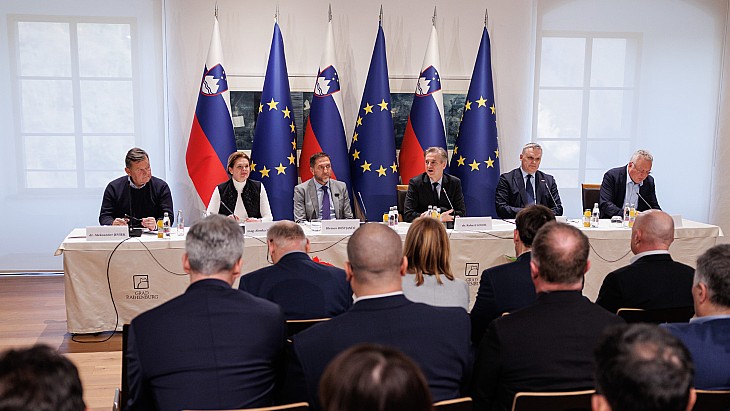
He was speaking after the Slovenian government took a decision to start the preparation of the National Spatial Plan for the new unit, which follows a four-month public consultation last year.
The decision "sets out the type of national spatial planning procedure to be followed, the objectives of the planned spatial arrangements, a description of the proposed development and its key characteristics, the indicative siting area, and an explanation of the proposed solution".
According to a government announcement after the meeting, the government is expected to decide on the result of the National Spatial Plan in the autumn of 2028.
Golob said: "With this, we have formally begun a process that is a step towards concrete solutions and concrete data for the new nuclear power plant unit."
He said that at the time of the abandoned referendum on new nuclear in 2024 "there was talk that a referendum didn’t really make sense because we didn’t know exactly what we were deciding on".
"The process was launched today, and spatial planning is the first step on this path. We will decide on it in a referendum, which is expected to be at the end of 2027 or the beginning of 2028, when we will have all the information on the table … we will know where the block will be located, under what conditions it will be built, who the supplier will be, and what its final price will be," he added.
The prime minister, who was speaking during a visit to the Krško plant, said that a separate report was discussed, from the Ministry of Finance, about the most appropriate financing model to use: "It turns out that this is a very important issue. When it comes to the final price of electricity from a nuclear facility, according to global experience, as much as half of the price depends on financing costs. This is a type of project that is very capital-intensive, with long repayment periods. Therefore, the scheme and financing costs are key to financial success."
He said the prices outlined "are very favourable for the development of energy-intensive industry in Slovenia and the economic development of the country … we are happy to continue the procedures to reach the point in the next two years when citizens will be able to decide whether we want to build a second unit or not".
Background
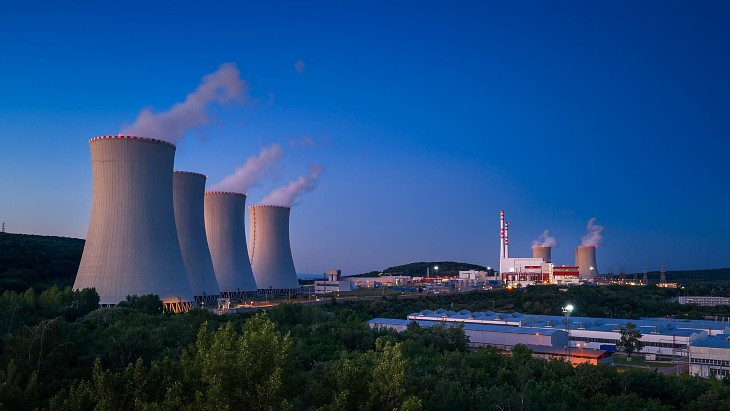
Slovenia's JEK2 project is for a new one or two-unit nuclear power plant, with up to 2,400 MW capacity, next to Krško NPP which has a 696 MWe pressurised water reactor generating about one-third of the country's electricity. Krško is owned and operated by Nuklearna Elektrarna Krško, which is jointly owned by Croatia's Hrvatska elektroprivreda (HEP Group) and Slovenia's GEN Energija. The indicative timeline is a Final Investment Decision in 2029, with construction beginning in 2033 and commercial operation in 2041.
Golob has said there will be a referendum before the new nuclear project gets to the construction phase - there had been one due to be held in November 2024, but that was called off amid a political row over how it was being conducted. Last year the two technology contenders - Westinghouse’s AP1000 and EDF’s EPR and EPR1200 reactors - were all judged to be suitable for the JEK2 site by the project company.
It also said the "estimated investment amount is also within the framework of the value of the economic study of the JEK2 project, prepared by GEN energija in 2024" - these ranged from EUR9.314 billion (USD10.1 billion) for a 1,000 MW unit and up to EUR15.371 billion for a 1,650 MW unit.


_33474.jpg)
_37830.jpg)
_85344.jpg)