_16171.jpg)
Kazakhstan has begun working towards the start of construction of its first nuclear power plant near the village of Ulken in the Almaty region: the plant has recently been named the Balkhash Nuclear Power Plant, following a competition run by the country's Atomic Energy Agency. In June, Rosatom was selected as the leader of an international consortium to build Kazakhstan's first planned nuclear power plant, using VVER-1200 pressurised water reactor technology.
The public hearings to discuss the construction site for the second nuclear power plant, which is expected to feature Chinese technology, were held in Ulken, and attended by village residents, community leaders, representatives of the local government, the Atomic Energy Agency of Kazakhstan, Kazakhstan Nuclear Power Plants LLC, and the Institute of Nuclear Physics RSE, the Agency said.
An analysis of potential sites for the second plant carried out by the Agency and Kazakhstan Nuclear Power Plants had been reviewed by the Interdepartmental Commission on the Development of the Nuclear Industry of the Republic of Kazakhstan, which recommended that the Zhambyl District of the Almaty Region be designated as the site for the construction of the second plant, the Agency said. Participants in the hearing were presented with information on those studies, key technical issues related to the construction of the second plant, measures to ensure the safe operation of the nuclear reactor, and the expected socioeconomic impacts.
"Kazakhstan will use Generation III+ reactors, where safety is ensured by the principle of multiple redundancy and a combination of passive and active protection systems. Modern reactors are recognised by the international community as environmentally friendly and safe," Gulmira Mursalova, Director of the Nuclear Energy Department at the Atomic Energy Agency of Kazakhstan said.
Daniyar Dzhanseytov, Director of the Agency's Kazakhstan Content Department, said the construction of the second nuclear power plant would grow the local production and create conditions for the development of small and medium-sized businesses in the region. "As global practice shows, one job at a nuclear power plant creates up to 10 new jobs in related sectors of the economy," he said.
European cooperation
Opportunities to ensure energy security and stability of supplies were discussed during the recent visit by EU President António Costa to Kazakhstan, with the Kazakh president's office describing the talks as "highly productive and held in an open, friendly, and constructive atmosphere".
"We also discussed opportunities to ensure energy security and stability of supplies and agreed to cooperate in broadening energy partnership into new areas such as critical minerals, nuclear sector, petrochemicals, as well as renewable energy," President Kassym-Jomart Tokayev said. "Our aim is to integrate Kazakhstan more deeply into European supply chains not just as a supplier of raw materials, but by developing local processing, value-added production, and recycling capacities in line with EU standards."
Cooperation between the European Union and Central Asia is entering a new phase of deepened engagement, Costa said, adding that Kazakhstan, as the third largest oil and uranium supplier for the bloc, is a key partner for its energy security.
The talks also looked at strengthening transport and logistics connectivity, including the joint development of the Trans-Caspian International Transport Route.
"My message is clear: There is a strong opportunity to take our cooperation much further, and - as I reaffirmed to President Tokayev - the EU stands ready to help unlock this potential, for the benefit of both sides," Costa said.
Russian collaboration
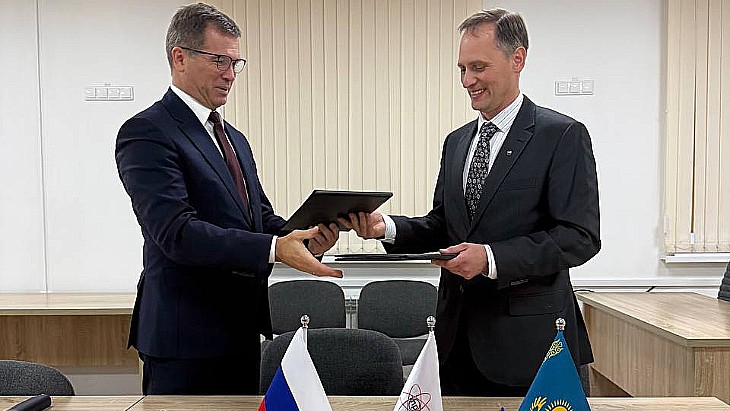
The document was signed by Ilya Vergizayev, General Director of RTS LLC, and Yevgeny Yermakov, Deputy General Director of the Institute of Nuclear Physics of Kazakhstan (Image: Rosatom)
Separately, Kazakhstan's Institute of Nuclear Physics has signed a memorandum of understanding (MoU) with Rosatom Technologies of Construction (RTS LLC, a part of the Rosatom State Corporation) confirming the intention to jointly develop a project for the construction of a multipurpose research reactor and laboratory complex in Kazakhstan. The agreement also covers the expansion of cooperation in the field of peaceful uses of nuclear energy.
"The projects to establish a research reactor and a Nuclear Science and Technology Center (NSTC) in the country will help address a number of important issues, including training specialists for the nuclear industry and expanding the country's scientific and industrial base," Ilya Vergizayev, General Director of RTS LLC, said. "The project to establish a research reactor in the Republic of Kazakhstan must be implemented with the full involvement of all relevant organisations in the country. Russia, represented by Rosatom, is ready to provide the necessary support."


_33474.jpg)
_37830.jpg)
_85344.jpg)